

Módulos & Calculadoras[01]
Calculadora de IMC
Calculadora de TMB & GET
Calculadora de Macronutrientes
Calculadora de Hidratação
Discover why strengthening your lower body goes far beyond aesthetics and how it truly transforms your metabolism.
Editor e Criador do Metaboliza
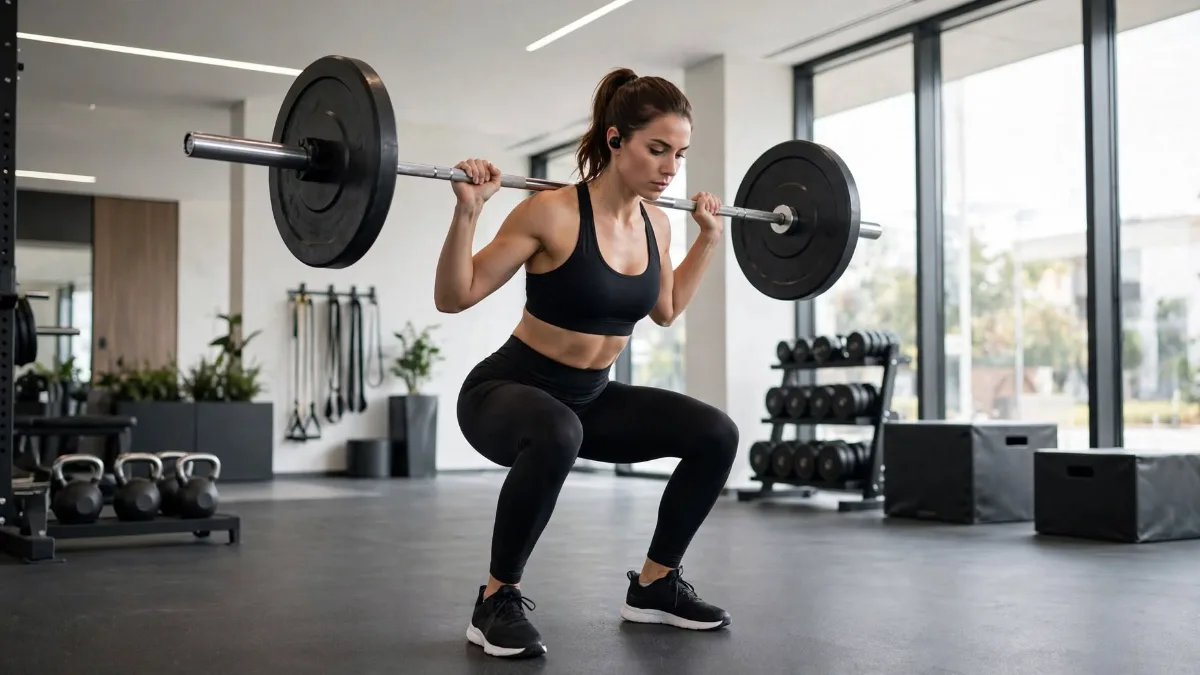
Squat practice in a modern and well-lit environment, representing leg training.
Who hasn't heard the famous joke about skipping leg day at the gym? Jokes aside, neglecting your lower body is one of the most common mistakes made by those seeking health, longevity, and a functional body. The truth is that the importance of lower body training goes far beyond having toned thighs or visible calves.
In exercise physiology, the legs represent a true energetic powerhouse. We are talking about a structure that houses the largest muscle groups in the human body—quadriceps, glutes, and hamstrings. When you decide to give these muscles proper attention, your entire organism responds systemically, generating adaptations that improve everything from your daily posture to how your body handles nutrients.
Let's be straight with each other: why do so many people run away from this workout? Generally, because it demands high endurance, causes that characteristic muscle fatigue, and engages the entire body. But it is precisely this 'heavy lifting' that brings the most impressive results for your long-term health.
Embracing leg day is a game-changer not just for muscle growth, but for maximizing your daily caloric burn and metabolic efficiency.
When it comes to caloric expenditure, the lower limbs are the true protagonists. According to data compiled by institutions like the Mayo Clinic and Harvard Health Publishing, strength training focused on large muscle masses is one of the most potent tools to optimize basal metabolism.
To start, think of muscle tissue as an engine that consumes energy all the time, even when you're on the couch watching your favorite show. Muscle tissue burns approximately three times more calories per pound at rest than adipose tissue (fat). Since the musculature of the legs and glutes makes up about 40% to 50% of the body's total lean mass in healthy individuals, every gram of muscle built in this region increases your daily energy consumption.
Additionally, there is the famous EPOC effect (excess post-exercise oxygen consumption). Classic studies reviewed in scientific literature show that intense sessions involving large muscle masses provoke a robust endocrine response and elevate the basal metabolic rate for up to 24 to 48 hours after the workout ends. In practical terms: you continue to burn a little more energy while your body recovers from the effort.
The EPOC effect ensures your body keeps burning calories long after you leave the gym, thanks to the recovery demands of large muscle groups.
The benefits of leg training for metabolism are fascinating, but the reflections in your daily routine are even more noticeable. After all, we use our legs for absolutely everything: getting out of a chair, climbing stairs, walking at the grocery store, and carrying bags.
First, strengthening prevents lower back pain and relieves overload on the spine. Biomechanical stability begins in the hips and glutes; if this base is weak, the spine ends up compensating for the effort. Second, joint health thanks you. Strong muscles around the knees act as natural shock absorbers, reducing direct impact on the joints.
The third point is a drastic improvement in insulin sensitivity. Because leg muscles are large glucose 'sponges', they help remove sugar from the bloodstream very efficiently, aiding in glycemic regulation. The fourth benefit is the increase in functional strength for longevity, guaranteeing autonomy in old age. And finally, the fifth benefit is improved blood circulation, since calf contraction acts as a true peripheral heart, pumping blood back upward.
Stronger legs mean better joint protection, improved blood circulation, and superior glucose regulation.
To put together an intelligent workout—whether at the gym or looking for leg exercises to do at home—it's worth understanding what we're dealing with. The body doesn't work in isolated compartments, but knowing the main muscle groups helps create variety and avoid imbalances.
In the front of the thigh, we have the quadriceps, responsible for straightening the knee and fundamental in movements like squats and step-ups. In the back, the hamstrings work on knee flexion and hip extension. Right above, the glutes (maximus, medius, and minimus) form the control center of our pelvic stability.
We cannot forget the calf (composed of the gastrocnemius and the soleus). It not only supports walking, but plays an essential circulatory role. Working all these groups in an integrated manner ensures that the body develops symmetrically, functionally, and free from unwanted postural compensations.
Balanced development across quads, hamstrings, glutes, and calves ensures optimal movement patterns and injury prevention.
There is a lot of confusion when it comes to why you should train legs and its direct relationship to weight loss. A very common question is: does leg training help you lose weight? The short answer is: indirectly, yes, and very efficiently.
It is essential to clarify a health and safety point: no exercise in the world is capable of burning localized fat just in the legs (or any other specific part of the body). When you lose fat, the body does it systemically, dictated by your genetics. However, because leg training burns many calories during execution and elevates metabolism in the hours following through EPOC, it creates a perfect scenario for the caloric deficit necessary for weight loss.
Another frequent myth is the fear of 'getting too big' quickly. Building muscle mass requires years of consistency, a caloric surplus in the diet, and favorable genetics. For the vast majority of people, what leg training does is sculpt the silhouette, tone tissues, and provide that much-desired firmness, in addition to protecting metabolic health.
Spot reduction is a myth, but full-body fat loss is greatly accelerated by the high caloric demand of leg workouts.
If you've been sedentary for a long time or are just getting back into training, take a breath! Enthusiasm is great, but haste is the main ally of injuries. Excessive loads without professional guidance put disproportionate pressure on the knees and lumbar spine, which can generate unwanted chronic pain.
Start by mastering your own body weight. Movements like free chair squats (sit-to-stands) or floor pelvic bridges are excellent starting points to build body awareness and strengthen joints before adding any bar or dumbbell.
Consistency always beats exaggerated intensity. It is much better to do moderate sessions two or three times a week than to overdo it on a single day and spend the next ten days feeling debilitating pain. Respect your rest time and always seek the guidance of a physical education professional to adjust movement execution to your biotype.
Master bodyweight movements and consistency first. Build a solid foundation before adding heavy weights.

✔ Aumenta a força e a resistência muscular; ✔ Potencializa a recuperação após treinos intensos; ✔ Eleva a energia e disposição para desempenho máximo; ✔ Auxilia no ganho de massa muscular magra. ✔ Ingrediente 100% puro e certificado.
Aviso de Saúde
O conteúdo deste artigo é puramente informativo e educacional, baseado em pesquisas publicadas. Ele não substitui o aconselhamento, diagnóstico ou tratamento médico profissional. Consulte sempre um médico ou nutricionista antes de realizar mudanças na sua dieta, treino ou suplementação.
Criador do Metaboliza, focado em simplificar a ciência da nutrição, metabolismo e biohacking para uma vida de alta performance.
Participe da discussão com a comunidade do Metaboliza