

Módulos & Calculadoras[01]
Calculadora de IMC
Calculadora de TMB & GET
Calculadora de Macronutrientes
Calculadora de Hidratação
We compare the pavement and the pedals to help you choose the best activity for your metabolism and routine.
Editor e Criador do Metaboliza

A man running outdoors and a cyclist riding on an urban bike path, representing the classic dilemma.
Anyone who has never stared at a pair of running shoes on one side and a shiny bicycle in the garage on the other, cast the first stone. Both activities are popular favorites, offering a generous dose of endorphins and fitting perfectly into the routine of those looking to overcome a sedentary lifestyle. But when it comes to optimizing time and seeking real results, the question remains: running or cycling?
The short and honest answer is that there is no absolute winner. Scientific consensus suggests that the best exercise is the one that aligns with your biology, your joints, your health goals, and, of course, what you actually enjoy doing. What works wonderfully for your friend might not be ideal for your knee or your specific routine.
In this article, we will dive into the scientific data, compare calorie burn, understand the impact on the skeletal system, and discover how each of these modalities affects your metabolism. Grab your water bottle and let's understand which path to follow.

Two paths, one goal: improving metabolic and cardiovascular health.
If your primary focus is burning calories and accelerating weight loss, you need to look at the numbers closely. According to data compiled by the Harvard T.H. Chan School of Public Health and guidelines from the Mayo Clinic, running typically leads the ranking of energy expenditure per unit of time when compared to cycling at a moderate pace.
In practical terms, a person running at a steady pace of about 5 mph (8 km/h) burns between 600 and 800 calories per hour. Meanwhile, moderate cycling (between 12 and 14 mph or 19-22 km/h) usually burns around 400 to 600 calories in the same period. The physical explanation is simple: in running, you must lift and propel 100% of your own body weight against gravity with every step.
However, here enters a crucial detail that many forget. Since cycling generates less immediate mechanical fatigue and lower acute muscle damage, many people can cycle for two or three consecutive hours—something unfeasible for most beginner runners. In other words, running wins in the short-term sprint, but cycling can compensate in total volume if you have more free time. It is also worth remembering that no exercise works miracles without a proper nutritional plan—after all, a caloric deficit starts in the kitchen.
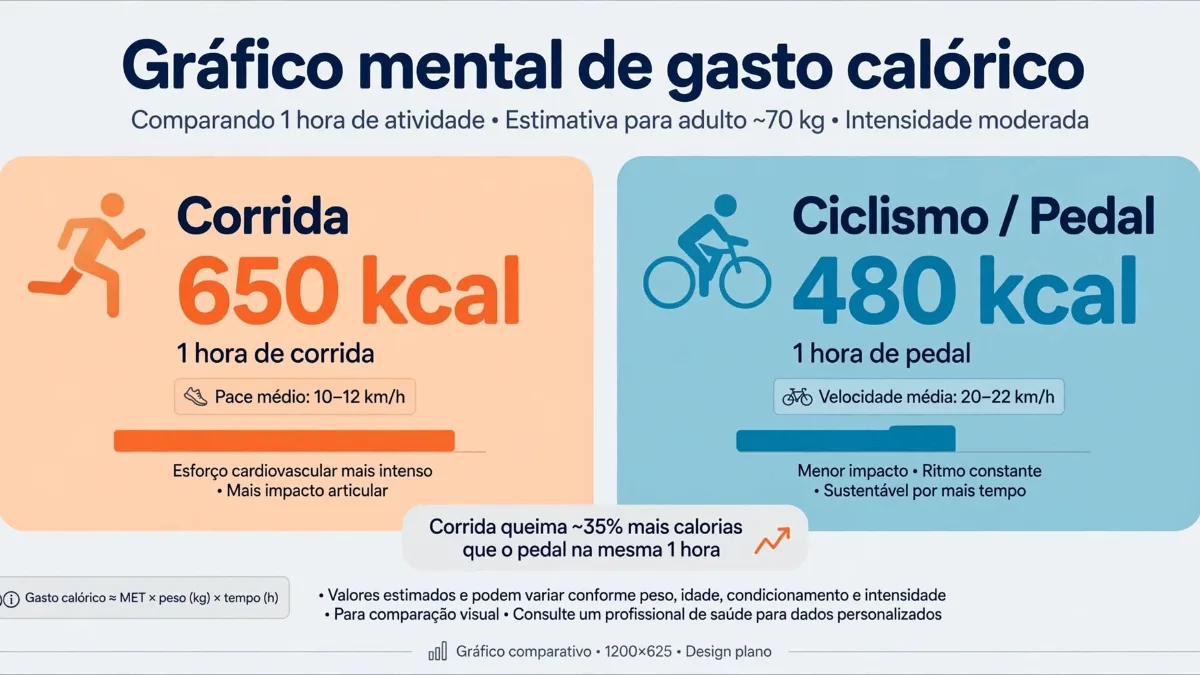
Mental chart of calorie burn comparing one hour of running versus one hour of cycling.
To maximize fat oxidation, try incorporating intervals (HIIT) into either modality, alternating periods of high intensity with active recovery.
This is where the game completely changes. While running wins in terms of fast calorie burning, cycling is the champion when it comes to joint preservation. Running is a high-impact exercise: biomechanical research shows that with every stride, the body absorbs forces that reach 3 to 4 times your own body weight.
For those with healthy joints, this controlled mechanical stress is excellent, as it stimulates tissue adaptation. However, for individuals with significant excess weight (Grade II or III obesity), a history of knee injuries, or chronic hip problems, this gravitational load can be excessive and risky without rigorous prior physical preparation.
On the other hand, cycling is considered a low-impact exercise. Since the saddle and pedals support most of your weight, the knee and ankle joints suffer much less from friction and mechanical shock. This is why orthopedists frequently recommend stationary bikes or outdoor cycling for rehabilitation processes or for those who wish to train with high volume without damaging their joints.
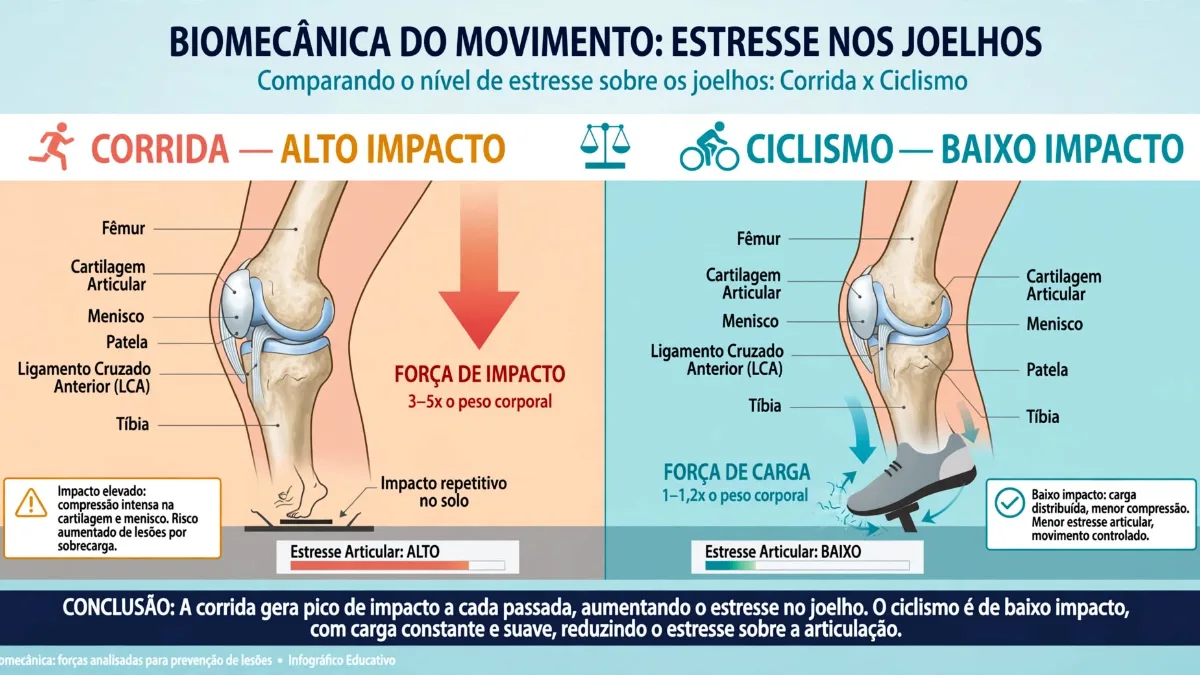
The biomechanics of movement define the level of stress on the knees.
There is a myth that all impact is bad, but human biology functions on the basis of stimulus and response. The American College of Sports Medicine points out that the mechanical stress generated by impact activities like running is fundamental for stimulating bone remodeling and mineral density.
Comparative studies among elite athletes show that runners tend to have significantly higher bone density in weight-bearing areas (such as the spine and femur) than exclusive cyclists. This happens because cycling, being a seated sport without direct gravitational impact, does not offer the same osteogenic stimulus (strong bone formation). Cyclists, therefore, need to pay attention to bone health and often complement their training with resistance training (weightlifting).
Conversely, regarding systemic metabolism—such as improved insulin sensitivity, glucose uptake by muscles, and increased VO2 max—both modalities technically tie. Both running and cycling release substances called myokines, which combat low-grade chronic inflammation and keep your metabolism running at full speed.
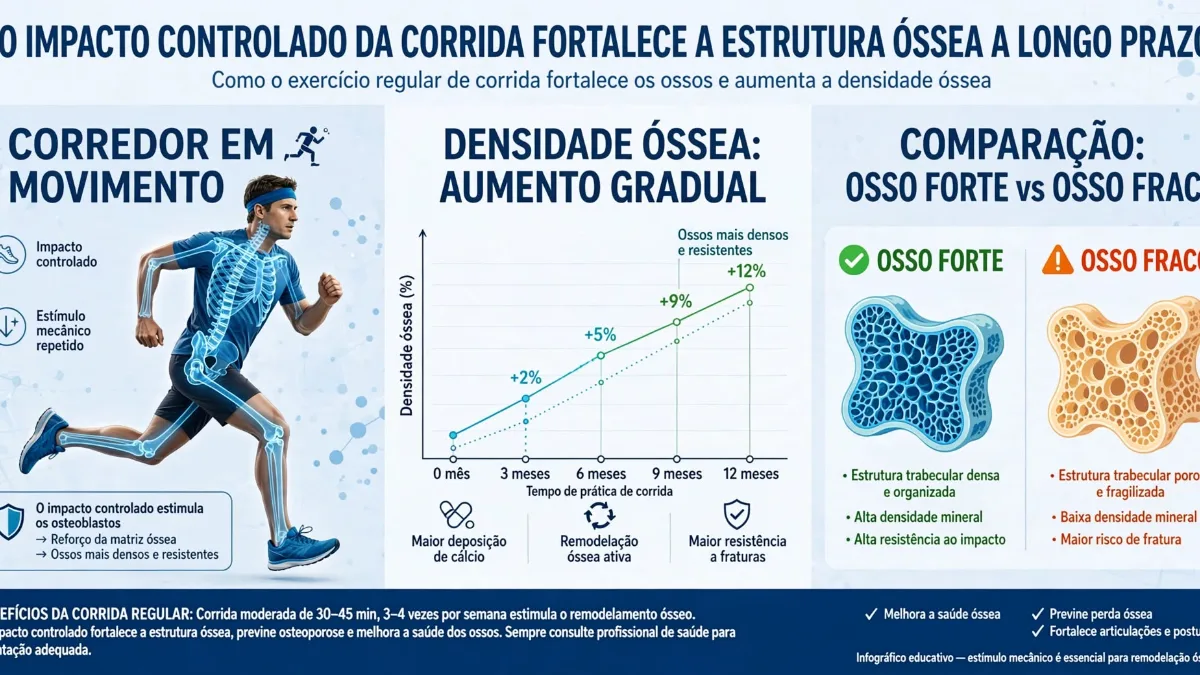
The controlled impact of running strengthens bone structure in the long term.
The definitive choice between running or cycling should be guided by an honest self-assessment of your current reality. If you have little time available in your daily schedule, enjoy practicality (all you need is a pair of sneakers and the front door), and seek a quick stimulus to burn calories and strengthen bones, running is a formidable choice.
However, if you are returning to training after a long sedentary period, deal with frequent joint pain, have considerable excess weight, or prefer long, contemplative outdoor workouts without suffering from mechanical wear and tear, cycling will embrace you in a much gentler and more sustainable way.
Always remember the golden rule of health safety: before starting any high-intensity program, especially if you have pre-existing medical conditions, undergo a complete medical evaluation. Avoid the classic mistake of trying to do everything in the first week—overtraining and drastic increases in load are the main shortcuts to a frustrating injury.

Planning and physical self-awareness are the pillars of any successful routine.
**Is it possible to combine both running and cycling?** Yes, this is known as cross-training. Combining both can offer the bone-strengthening benefits of running while allowing for the active recovery and joint protection of cycling.
**Which is better for heart health?** Both are excellent cardiovascular exercises. The best one for your heart is the one you can perform consistently at an intensity that elevates your heart rate into the aerobic zone.

Aviso de Saúde
O conteúdo deste artigo é puramente informativo e educacional, baseado em pesquisas publicadas. Ele não substitui o aconselhamento, diagnóstico ou tratamento médico profissional. Consulte sempre um médico ou nutricionista antes de realizar mudanças na sua dieta, treino ou suplementação.
Criador do Metaboliza, focado em simplificar a ciência da nutrição, metabolismo e biohacking para uma vida de alta performance.
Participe da discussão com a comunidade do Metaboliza