

Módulos & Calculadoras[01]
Calculadora de IMC
Calculadora de TMB & GET
Calculadora de Macronutrientes
Calculadora de Hidratação
Discover the benefits of strength training in the third age, learn how to prevent sarcopenia, and find out the essential precautions to train safely.
Editor e Criador do Metaboliza
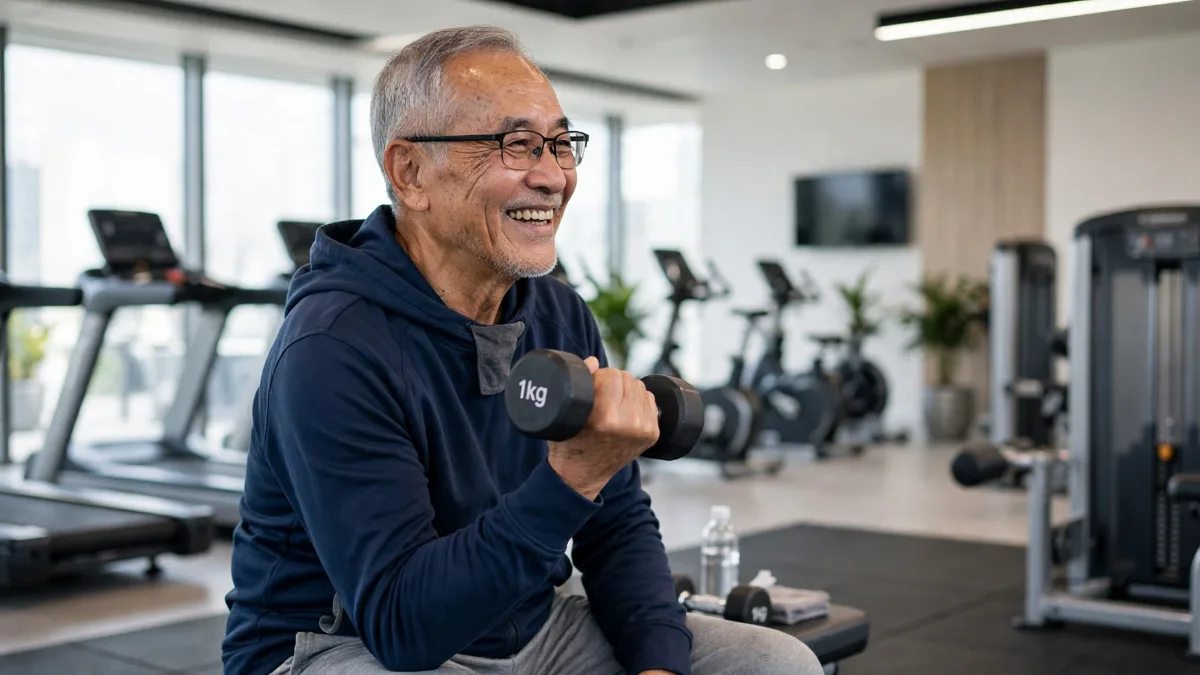
Elderly man smiling while doing light strength training in a modern, well-lit gym.
Talking about aging nowadays goes far beyond accumulating birthdays; it is about how we get there. For decades, the myth was created that the gym, weights, and machines were exclusive territories for young people seeking aesthetics. The good news — backed by solid recent scientific consensus — is that reality has completely changed. Strength training in the third age is no longer a simple optional recommendation and has become a true pillar of public health and longevity with autonomy.
According to guidelines from health organizations and official positions from bodies like the National Strength and Conditioning Association (NSCA), the risk of maintaining a sedentary routine far outweighs the risks associated with a well-supervised resistance exercise program. In other words, the human body was made to move and resist forces throughout its entire existence. When we stop challenging our muscles, the organism understands that it no longer needs to spend energy to keep them strong, initiating an accelerated process of physical decline.
The major turning point happens when we understand that the gym in maturity is not about chasing load records, but rather ensuring that you can get up and sit down from a chair without help, carry groceries safely, and climb stairs without losing your breath. It is the most efficient tool to maintain the functional independence that everyone wishes to preserve over the years.
Resistance training in older age is not about lifting heavy weights, but about preserving the functional independence needed for daily activities.
You may have already noticed that, as the years go by, maintaining the same weight or physical strength seems to require a much greater effort. This process has a name: sarcopenia. It is the progressive loss of skeletal muscle mass, strength, and function associated with natural aging. Studies compiled by geriatric societies indicate that, starting at age 50, if there is no type of resistance stimulus, a person can lose between 1% and 2% of muscle mass per year. Sounds small? Over a decade, this can represent up to 20% of your strength and functionality.
This is where exercises for sarcopenia in seniors come in, acting as the most powerful 'medicine' to brake this process. Strength training sends a clear signal to the neuromuscular system that muscles are still needed. When you push, pull, or lift a controlled load, micro-tears occur in the muscle fibers which, upon recovering with proper rest and nutrition, become stronger and thicker.
The medical literature is impressive in this regard: clinical data show that older adults can increase muscle strength by up to 100% or more after a consistent 8-to-12-week strength training program. This means it is never too late to rebuild what time tried to take away, regardless of whether you have never set foot in a gym before.
The positive reflexes of strength training in the third age go far beyond arms and legs. When we talk about metabolism, muscle tissue acts as a true endocrine and metabolic organ. Active muscles consume more glucose, which impressively improves insulin sensitivity. For those dealing with type 2 diabetes or wanting to prevent it, strength training is a formidable ally, helping to keep blood sugar levels under control in a much more stable way.
In addition, bone health receives an extraordinary bonus. Bones are living structures that respond to mechanical impact and traction. When the muscle contracts and pulls the bone during strength exercise, it stimulates osteoblast cells to produce more bone matrix, increasing the skeletal mineral density. It is one of the most effective ways to prevent osteoporosis and avoid severe fractures resulting from falls — one of the greatest health risks in maturity.
We also cannot forget the cardiovascular system and the mind. According to publications from institutions like the Mayo Clinic, the regular practice of resistance exercise helps manage blood pressure and releases neurotransmitters linked to well-being, reducing anxiety symptoms and improving sleep quality. It is body and mind working in perfect harmony.
Despite all the well-deserved praise for strength training, common sense must always prevail. After all, we are talking about a body that has a history, experiences, and often some comorbidities such as controlled hypertension, osteoarthritis, or chronic joint pain. The first commandment of strength training for seniors is safety: NEVER start an intense exercise program without first undergoing a complete medical evaluation.
The cardiologist or geriatrician needs to clear the practitioner and evaluate if there is any specific restriction, especially in the cardiovascular system. Furthermore, the presence of a qualified physical educator is non-negotiable. This professional will adjust posture, adapt equipment, and ensure that the execution of movements is flawless, avoiding unwanted overloads on the joints.
Another critical point is load progression. No trying to lift your grandchild's weight on the very first day! The motto must be slow and steady. Pay close attention to the body's warning signs: sharp joint pain, dizziness, excessive shortness of breath, or a feeling of fainting are reasons to stop exercising immediately and report it to the instructor or physician.
After all, how does the routine work in practice? The recommended consensus for most older adults revolves around 2 to 3 weekly sessions of strength training, ensuring at least one rest day between sessions to allow adequate muscle recovery. The main focus should be on major muscle groups — legs, back, chest, and core — utilizing both guided machines (which offer more initial stability) and free weights or bodyweight exercises.
But the workout itself is only half the equation. The other fundamental pillar is nutrition combined with rest. As we age, our ability to absorb and utilize proteins to build muscle decreases slightly (a phenomenon known as anabolic resistance). Therefore, ensuring an adequate intake of good quality protein in meals — such as eggs, chicken, fish, lean meats, or equivalent plant-based options — is indispensable to fuel muscle recovery.
Finally, hydration and restful sleep complete the recipe for success. Sleeping well is when the body truly repairs itself, consolidates strength gains, and balances hormones. With consistency, patience, and guidance, strength training goes from being a medical obligation to becoming the most enjoyable part of your week.

CREATINA MONOHIDRATADA PURA: 5g de creatina por porção, sem excipientes, sem aromatizantes. A forma mais estudada e validada para auxílio no desempenho em exercícios de alta intensidade.
Aviso de Saúde
O conteúdo deste artigo é puramente informativo e educacional, baseado em pesquisas publicadas. Ele não substitui o aconselhamento, diagnóstico ou tratamento médico profissional. Consulte sempre um médico ou nutricionista antes de realizar mudanças na sua dieta, treino ou suplementação.
Criador do Metaboliza, focado em simplificar a ciência da nutrição, metabolismo e biohacking para uma vida de alta performance.
Participe da discussão com a comunidade do Metaboliza