
Módulos & Calculadoras[01]
Calculadora de IMC
Calculadora de TMB & GET
Calculadora de Macronutrientes
Calculadora de Hidratação
Discover how this essential micronutrient works silently in your body, from blood clotting to protecting your blood vessels.
Editor e Criador do Metaboliza
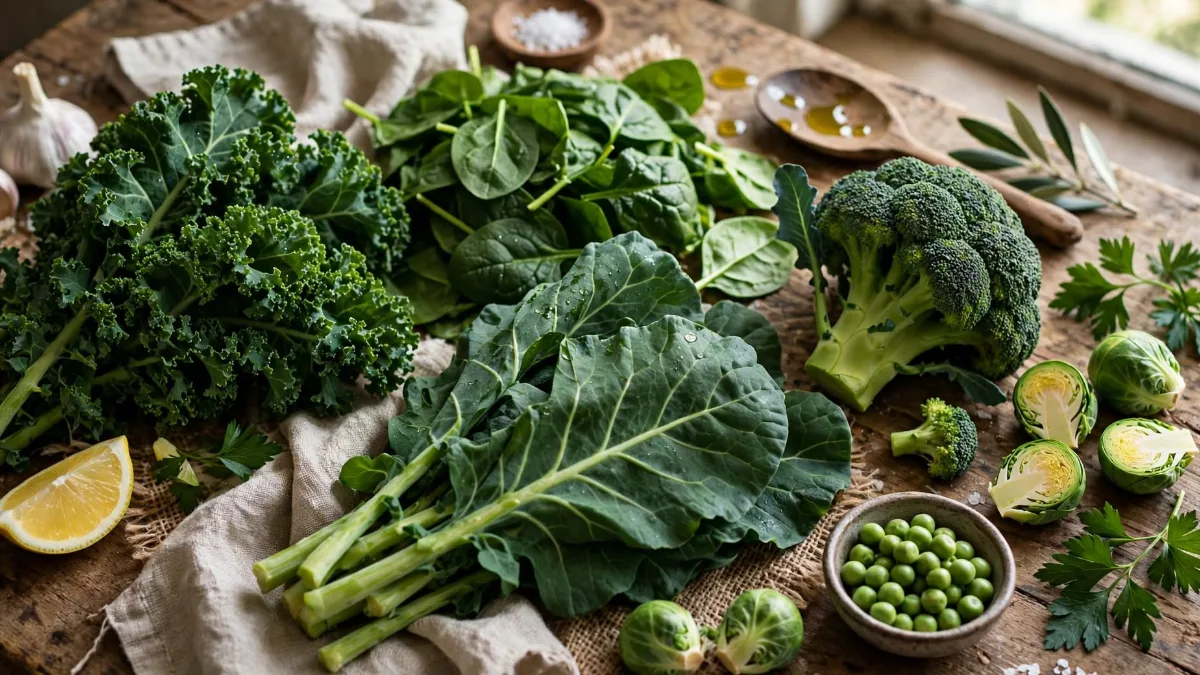
Dark green leaves and vitamin K-rich foods arranged on a wooden table.
When we think of vitamins that govern our metabolism, names like vitamin D or the B-complex usually steal the spotlight. However, there is a fat-soluble micronutrient — meaning it dissolves in fats — that performs absolutely vital functions to keep our engine running smoothly without stalling: vitamin K.
Historically, science discovered vitamin K because of its indispensable role in the blood clotting cascade. Without it, any minor cut could turn into a serious problem, as the body would lose the ability to stop bleeding efficiently. But modern research has greatly expanded this horizon, showing that vitamin K's action goes far beyond the liver, reaching crucial peripheral tissues.
In biochemical terms, it acts as an essential cofactor for the enzyme gamma-glutamyl carboxylase. In simpler words, it works as the key that turns on vitamin K-dependent proteins (known as VKDPs). Think of them as specialized tools that need to be 'activated' to do the heavy lifting of directing calcium to the right place in our body.
One of the most common questions for those starting to research the topic is understanding why we hear about different types of this nutrient. The truth is that the vitamin K family is mainly divided into two large groups with very distinct behaviors and origins in the organism.
Vitamin K1, scientifically called phylloquinone, is the form found mostly in dark green leafy vegetables. When we consume it, it travels straight to the liver, where it fulfills its classic and primary role in regulating clotting factors. It is the most abundant form in our diet.
On the other hand, vitamin K2, known as menaquinone (with emphasis on subtypes like the famous MK-7), has a predominantly bacterial origin and is found in fermented foods and animal products. The great advantage of K2 is its excellent bioavailability in peripheral tissues, such as bones and blood vessel walls, where it performs fascinating metabolic functions.
Knowing what vitamin K is used for means understanding how our body manages calcium intelligently. After all, calcium is great for hardening bones, but terrible when it accumulates where it shouldn't, such as in the arteries.
In bone tissue, vitamin K2 activates a protein called osteocalcin. It is the one that literally 'holds' calcium and fixes it firmly into the bone matrix, ensuring denser and stronger bones. Data compiled in an important meta-analysis of 16 randomized clinical trials — involving more than 6,400 participants — confirmed that vitamin K2 supplementation significantly improves lumbar spine bone mineral density in postmenopausal women.
In the cardiovascular system, vitamin K comes into action by activating another fundamental protein: matrix Gla protein (MGP). This protein acts as a true shield, preventing calcium from depositing on arterial walls. Clinical trials have shown that vitamin K action helps reduce critical biomarkers of arterial calcification, promoting greater elasticity and health for blood vessels. Furthermore, classic observational studies, such as the famous Rotterdam Study, associated higher vitamin K2 intake with an expressive reduction in the risk of coronary issues.
The good news for those who enjoy eating well is that vitamin K is widely available in everyday foods. You don't need exotic ingredients to ensure good amounts of this nutrient on your plate.
If your focus is vitamin K1, dark green vegetables are the undisputed kings. Kale, spinach, broccoli, watercress, and Swiss chard lead the concentration ranking. A simple sautéed kale or a generous spinach salad provides a robust dose of the nutrient.
For those seeking vitamin K2, options shift to animal-based and fermented foods. Pastured egg yolks, high-quality butter, liver, aged cheeses, and traditional dishes like natto (fermented Japanese soybeans) are valuable primary sources. It is worth noting that the established daily Adequate Intake (AI) for adults is 120 mcg for men and 90 mcg for women, goals easily achieved with a balanced diet.
Pairing your dark leafy greens with a healthy fat (like olive oil or avocado) significantly boosts the absorption of fat-soluble vitamins like K1.
Although severe clinical vitamin K deficiency is considered rare in healthy adults — mainly because our diet usually provides the minimum and our gut microbiota also produces small quantities —, subclinical insufficiency is a topic that has been gaining a lot of attention from the scientific community.
When the deficiency is pronounced, the most classic and dangerous symptom is bleeding disorders. Since blood loses the ability to clot normally, minor cuts may bleed for a long time, and spontaneous bruises can easily appear all over the body.
On the other hand, long-term subclinical insufficiency — where the person has no hemorrhages but consumes less than ideal — is silently associated with progressive bone loss and a greater propensity for vascular stiffness due to inappropriate calcium accumulation. That is why maintaining an adequate dietary intake makes all the difference for long-term well-being.
We have reached an absolutely critical point that requires redoubled attention: the relationship between vitamin K and medications. If you or someone close to you takes oral anticoagulants (such as warfarin), this is a warning that can save lives.
⚠️ ATTENTION: Vitamin K directly antagonizes the effect of anticoagulant medications. This means that sudden and drastic changes in the consumption of dark green vegetables rich in vitamin K can simply alter the efficacy of your medication, increasing the risk of clots or bleeding.
This does not mean that those taking anticoagulants cannot eat a salad! The golden rule, endorsed by cardiologists and nutritionists, is consistency. You must maintain a stable and routine consumption of these foods, always informing your doctor and nutritionist about any changes in your diet. Furthermore, avoid starting any vitamin K supplementation — especially high-dose K2 MK-7 — without strict medical supervision, as safety and personalized dosage depend on individual clinical evaluation.
Aviso de Saúde
O conteúdo deste artigo é puramente informativo e educacional, baseado em pesquisas publicadas. Ele não substitui o aconselhamento, diagnóstico ou tratamento médico profissional. Consulte sempre um médico ou nutricionista antes de realizar mudanças na sua dieta, treino ou suplementação.
Criador do Metaboliza, focado em simplificar a ciência da nutrição, metabolismo e biohacking para uma vida de alta performance.
Participe da discussão com a comunidade do Metaboliza