
Módulos & Calculadoras[01]
Calculadora de IMC
Calculadora de TMB & GET
Calculadora de Macronutrientes
Calculadora de Hidratação
Discover how to fuel your metabolism just right, avoid discomfort, and perform much better at the gym.
Editor e Criador do Metaboliza
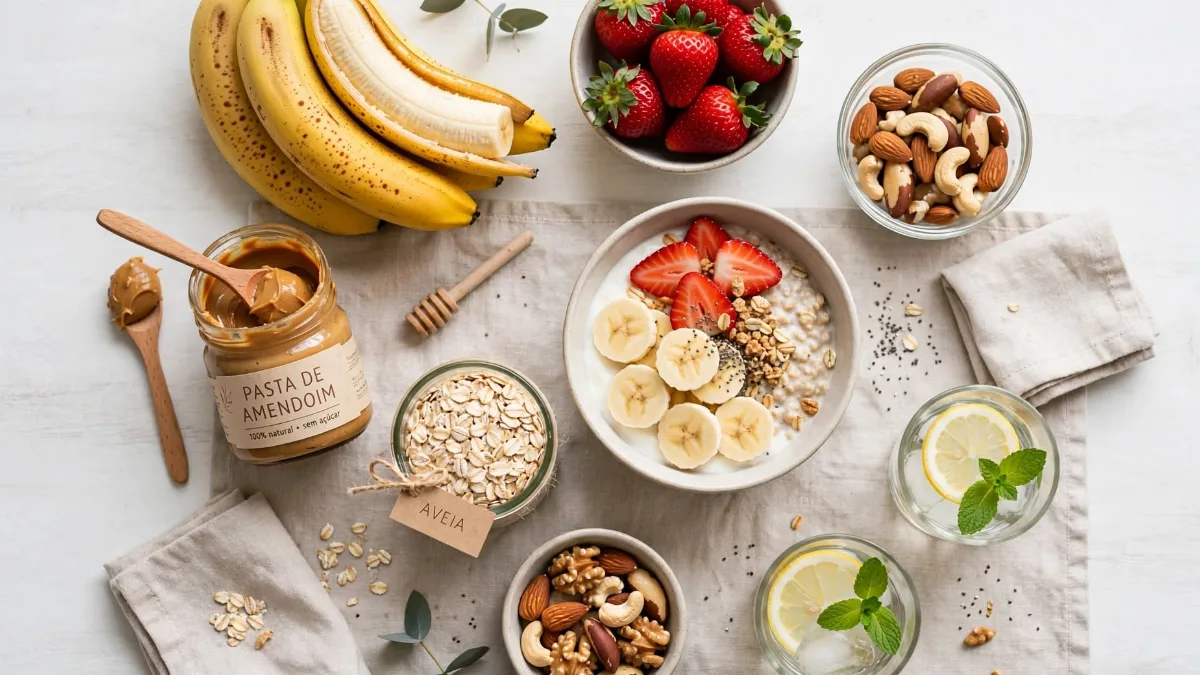
An organized table with healthy pre-workout options such as fruits, oatmeal, and nuts.
You know that feeling of going to work out and feeling like you're pulling an anchor instead of lifting weights? Often, the culprit isn't daily fatigue, but an empty fuel tank. When we talk about what to eat before a workout, we are dealing directly with how your metabolism manages energy to deliver performance without sacrificing your muscle mass.
The human body functions like a sophisticated hybrid car. It needs quick sources of energy to handle intense efforts and, at the same time, needs stability to maintain pace until the very last exercise. When you skip this meal, your organism has to scramble to find glycogen or, in more prolonged cases, tap into muscle tissue to meet the demand. And nobody wants to lose that hard-earned muscle, right?
Beyond the purely energetic aspect, eating properly before exercising protects your system against sudden drops in blood pressure, dizziness, and that annoying weakness mid-set. It is the starting kick that tells your metabolism: 'Go ahead and accelerate, we have plenty of fuel.'
If the pre-workout were an action movie, carbohydrates would be the unquestionable protagonist and protein would be the loyal sidekick that ensures everything ends well. Many people are afraid of carbs, but in the pre-exercise context, the best pre-workout carb is your greatest ally for generating strength and muscular explosion.
Carbohydrates are rapidly converted into glucose, which goes straight into the bloodstream and muscles in the form of glycogen. It is this molecule that fuels every muscle contraction. If you are looking for what to eat before a workout to gain mass, this duo becomes even more important, as protein ingested before or right after the stimulus helps signal protein synthesis and protects muscle fibers.
The ideal choice falls on moderate- to fast-digesting carbohydrates—depending on how much time is left before exercise—combined with a small portion of lean protein. Think of simple combinations like a banana with peanut butter or a slice of whole-wheat bread with white cheese. Nothing too heavy, just enough to shield your body and optimize gains.
You've probably been through the terrible experience of eating a heavy meal and going for a run right after, right? The result is never pretty. Nutritional timing—meaning the spacing between the meal and the exercise—is just as important as the quality of the food chosen.
When you eat, your body directs a considerable volume of blood to the digestive system to process nutrients. However, when you start working out hard, your muscles demand that same blood to receive oxygen. If both processes happen at the same time, an internal battle ensues that usually results in cramps, nausea, sluggishness, and stagnant digestion.
To avoid this gastric drama, the rule of thumb is simple: larger meals require more time (1 to 2 hours in advance), while quick, light snacks can be consumed very close to zero hour. If you only have 30 minutes, the ideal choice is to rely on liquid foods or those of very low digestive complexity.
A busy routine often forces us to improvise, but that doesn't mean resorting to just any junk food from the vending machine. Having a quick and healthy pre-workout snack in mind saves any schedule and ensures you don't skip the most important meal of the day.
For those who train early in the morning, what to eat before a morning workout is usually a dilemma, since the stomach is still waking up. In these cases, light options that don't cause bloating are essential. A small and easy-to-digest fruit, like a banana or papaya with a handful of oats, usually does the trick perfectly without feeling heavy.
As for those who work out at night, after a full day of work, the scenario changes slightly. What to eat before a night workout should be light enough not to disrupt sleep, but consistent enough to guarantee energy during a spinning or weightlifting class. A small tapioca flatbread with egg or yogurt with sugar-free granola are safe and comforting bets.
Intermittent fasting and fasted workouts have become a craze in recent years, sparking heated debates on social media and in gyms. After all, to eat or not to eat before sweating? The short answer is: it depends on your goal, your level of adaptation, and, above all, your biological individuality.
From a scientific standpoint, training in a fasted state for healthy individuals performing light- to moderate-intensity exercise (like a brisk walk or a light jog) is entirely feasible and, for some, comfortable. The body utilizes fat reserves and remaining liver glycogen. However, for intense strength training, high-intensity intervals (HIIT), or muscle hypertrophy, the lack of carbohydrates can drastically drop performance, causing you to lift less weight or last less time.
⚠️ Heightened attention: People with metabolic conditions, such as diabetes or insulin resistance, should never adopt fasted training without strict medical or nutritional guidance. The risk of severe hypoglycemia, dizziness, and fainting is real and not worth the risk.
As important as knowing what to put on your plate is knowing what to keep away from it in the hours leading up to physical exertion. Certain foods, although healthy in everyday life, become true ticking time bombs when consumed before physical activity.
Excess fats (such as fried foods, bacon, heavy yellow cheeses, or large amounts of avocado and nuts) drastically slow down gastric emptying. The food gets 'stuck' in the stomach, generating that feeling of heaviness, acid reflux, and nausea while you try to do a crunch.
Foods rich in insoluble fibers in large quantities—such as beans, raw broccoli, cabbage, or heavy whole grains—also warrant immediate caution before a workout. They ferment in the digestive tract, producing gas, cramps, and abdominal distension that will ruin any focused and productive workout.
/hotmart/product_pictures/7e505501-ab9c-4c67-98f4-1cac750652c2/Designsemnome.png)
Receitas Anabólicas foi criado para quem quer maximizar seus resultados na academia com uma alimentação deliciosa e saudável. Inclui 30 receitas fitness e um bônus exclusivo com 10 doces fit.
Aviso de Saúde
O conteúdo deste artigo é puramente informativo e educacional, baseado em pesquisas publicadas. Ele não substitui o aconselhamento, diagnóstico ou tratamento médico profissional. Consulte sempre um médico ou nutricionista antes de realizar mudanças na sua dieta, treino ou suplementação.
Criador do Metaboliza, focado em simplificar a ciência da nutrição, metabolismo e biohacking para uma vida de alta performance.
Participe da discussão com a comunidade do Metaboliza