
Módulos & Calculadoras[01]
Calculadora de IMC
Calculadora de TMB & GET
Calculadora de Macronutrientes
Calculadora de Hidratação
Forget the stopwatch neurosis at the gym. Let's finally demystify the right time to take your supplement.
Criador do Metaboliza & Autor
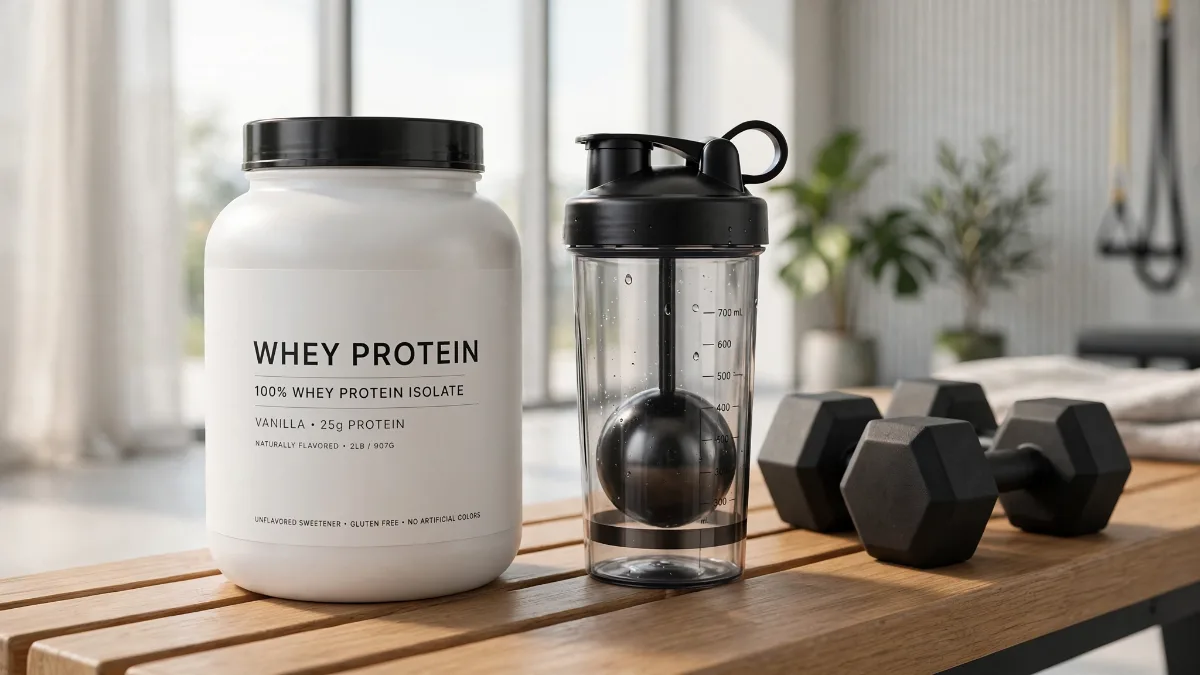
Whey protein tub next to a shaker and dumbbells in a bright, modern setting.
Who hasn't rushed to the locker room after their last bench press set, looking like a mad scientist trying to open a whey protein shaker before those blessed 30 magic minutes run out? The fitness industry trained us for years to believe that if the miraculous powder didn't enter the bloodstream lightning-fast after exercise, all our hard work with the weights would be lost.
The good news is you can breathe a sigh of relief. Sports science has evolved significantly, and today we understand that the human body is not such a fragile Swiss watch. Whey protein is, first and foremost, a tool of high practicality. It serves to hit your daily protein goal quickly and deliciously, without forcing you to chew yet another chicken breast at ten o'clock at night.
In this article, we will dive into the latest scientific evidence to answer the classic question: after all, what is the best time to take whey protein? We'll look at the before, the after, and most importantly, what truly moves the needle for your gym results.
To understand the timing controversy, we need to talk about the famous anabolic window. For years, it was believed there was a sort of 30 to 45-minute post-workout 'narrow door' where muscles were starved for nutrients, closing shortly after. Renowned meta-analyses, such as those led by researchers of the caliber of Brad Schoenfeld and Alan Aragon, turned that narrative upside down.
What current studies show is that the anabolic opportunity window is much more generous than previously thought. It can extend for an impressive 24 to 48 hours after an intense resistance workout. Although there is a peak in protein synthesis right after exercise—especially if you trained fasted—your body remains highly responsive to nutrients for a prolonged period.
This means that if you had a good protein-rich meal a few hours before lifting weights, the urgency to drink your shake the exact second you drop the bar drops drastically. The determining factor for muscle mass gains, according to guidelines from the International Society of Sports Nutrition (ISSN), remains the total protein intake over the 24 hours of the day, generally falling between 1.6g and 2.2g per kilogram of body weight.
Deciding to take whey protein before your workout can be an excellent strategy depending on your routine. If you are someone who works out early in the morning on an empty stomach, or goes many hours without eating before hitting the gym, tossing down a scoop helps provide circulating amino acids and prevents the discomfort of working out with low energy.
Clinical studies comparing protein intake immediately before versus immediately after exercise show very similar muscular adaptations. In other words, pre-workout whey is effective and perfectly fulfills its role of supplying essential amino acids (especially leucine) to the bloodstream during exertion.
However, you need to be careful with your stomach. Chugging a heavy shake and rushing to do crunches or intense exercises can cause significant gastric discomfort, nausea, and ruin your performance. If you choose the pre-workout route, give preference to a 30 to 60-minute window before you start sweating, or combine your whey with fast-digesting foods.
Post-workout whey captured the hearts of weightlifters for a very simple reason: convenience and practical efficiency. Following the mechanical stress of training, muscles are damaged and ready to kickstart the repair and growth process. Providing fast-absorbing protein at that moment ensures the necessary building blocks (amino acids) reach their destination quickly.
Additionally, the post-workout is a safe haven for anyone who trained without managing to eat properly beforehand. If you had a busy day and went straight to the gym, the post-workout shake acts as an immediate nutritional 'reset,' facilitating recovery and protein synthesis without requiring the digestive effort of a solid meal.
It's worth noting that the standard dose demonstrated by science to maximize this anabolic response is around 20g to 40g of protein per serving. Anything more than that won't magically convert into more muscle; the excess will simply be used by the body for other energetic functions or eliminated.
Let's set the record straight: stressing out over taking whey 10 minutes before or 15 minutes after your workout is focusing on a microscopic detail while ignoring the big picture. Think of your diet like a house: the total amount of protein you consume in 24 hours is the foundation and the walls. The exact timing of your supplement is, at best, the color of the curtains.
If your daily protein intake is below the ideal for your weight and goal, no magical supplement timing will save your gains. On the other hand, if you consistently hit your recommended daily target of 1.6g to 2.2g per kilogram of body weight, the results will come, regardless of whether you take your whey in the morning, afternoon, before, or after sweating it out.
⚠️ Important to highlight: supplements should never replace a complete and balanced meal. Real food—such as eggs, meats, fish, dairy, legumes, and grains—offers a micronutrient profile, fiber, and satiety that no isolated powder can replicate on its own. Furthermore, excessive protein consumption without guidance should be avoided by individuals with pre-existing kidney conditions. And if you are lactose intolerant or have a milk protein allergy, there are excellent plant-based protein alternatives (pea and rice) or beef protein.
At the end of the day, choosing between taking whey before or after your workout should be guided by a very simple compass: your own routine and gastric comfort. If you prefer to train with a light stomach, the post-workout is your ally. If you feel weak and lacking energy training on an empty stomach, a light pre-workout with whey will give you the necessary boost.
The secret to long-term success in nutrition and fitness is sustainability. Choose the schedule that best fits your daily life, causes no stomach upset, and helps you close your nutritional day without stress. Consistency beats perfection every single time.

Aviso de Saúde
O conteúdo deste artigo é puramente informativo e educacional, baseado em pesquisas publicadas. Ele não substitui o aconselhamento, diagnóstico ou tratamento médico profissional. Consulte sempre um médico ou nutricionista antes de realizar mudanças na sua dieta, treino ou suplementação.
Entusiasta de nutrição e biohacking, focado em simplificar a ciência da saúde.
Participe da discussão com a comunidade do Metaboliza