
Módulos & Calculadoras[01]
Calculadora de IMC
Calculadora de TMB & GET
Calculadora de Macronutrientes
Calculadora de Hidratação
Discover if the famous supplement really beats a good old plate of food when it comes to muscle recovery.
Editor e Criador do Metaboliza
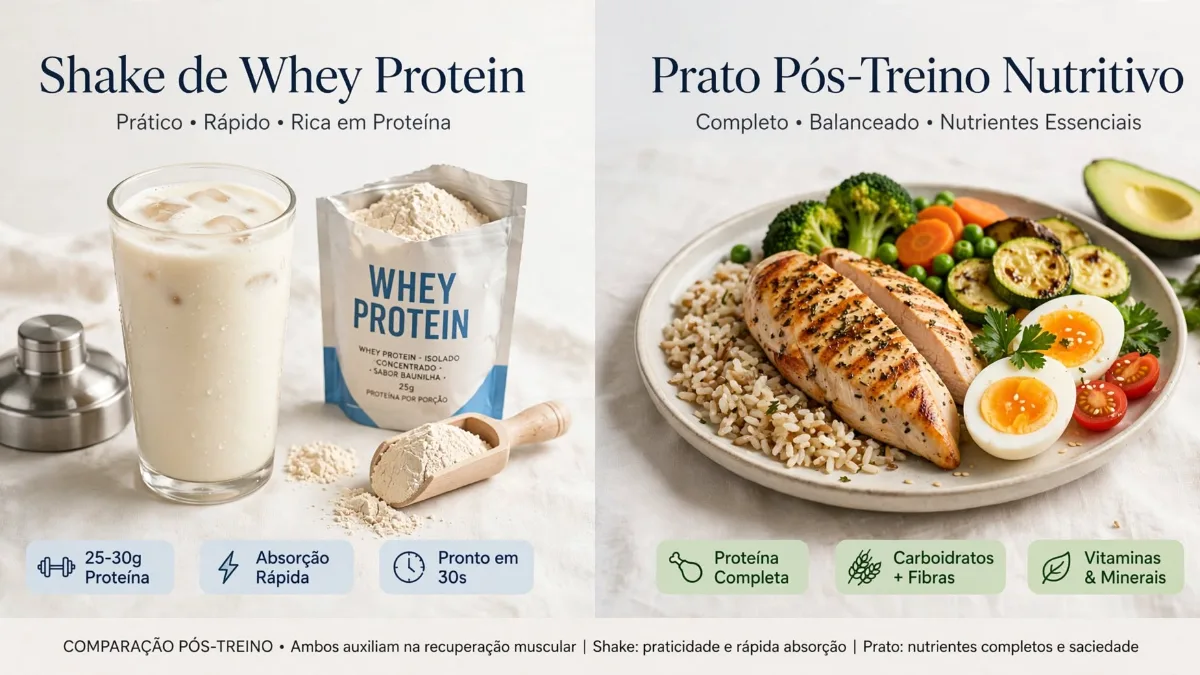
Visual comparison between a whey protein shake and a nutritious plate of food post-workout.
You've just finished a grueling weight-training session, dripping in sweat, and the big question pops into your head: rush to the locker room to shake up that foamy whey protein or head straight to the kitchen to build a solid meal?
This scene repeats itself in gyms everywhere. For years, fitness culture sold the idea that the supplement was an almost mandatory magic pass for anyone wanting to grow their muscles. However, when we look at real-life routines and nutritional science, the story is a bit more practical — and far less rigid.
The current scientific consensus indicates no absolute metabolic superiority of whey protein over solid food when it comes to hypertrophy. What truly moves the needle for muscle mass gain is the total calories and macronutrients you consume throughout the entire day. In other words, the supplement is a tool of convenience, not an indispensable magic potion.
Total daily protein intake matters much more for muscle growth than the exact source of your post-workout meal.
Remember that sacred rule stating you needed to drink your protein shake within exactly 30 minutes of your last exercise, or your entire workout would be in vain? Well, you can breathe a sigh of relief: that concept of a hyper-restricted anabolic window has been debunked.
Systematic reviews published in journals such as the Journal of the International Society of Sports Nutrition show that the window of opportunity for nutrient intake is much more elastic than previously thought. It can extend for 4 to 6 hours around your workout, varying depending on your pre-workout meal.
Furthermore, protein synthesis — the biological process of building new muscle tissue — remains elevated for up to 24 to 48 hours after an intense resistance training session. This means your body keeps working on recovery long after you've washed your shaker bottle or scraped your plate clean.
If whey protein isn't mandatory, why do so many people love this supplement? The short answer: convenience and biochemical efficiency.
Derived from milk whey, whey protein stands out for its extremely fast digestion and absorption rate in the gastrointestinal tract. It boasts an impressive concentration of about 10% to 12% leucine, an essential amino acid that acts literally as the ignition key for the mTOR pathway — the primary cellular trigger for muscle growth.
In scenarios where your routine is hectic — such as working out during your lunch break or right before battling rush-hour traffic — carrying a scoop of powder in your bag and mixing it with water or milk solves your nutritional needs in seconds. It also shines on days when your appetite is low after an exhausting workout, since drinking calories and nutrients is often much easier than chewing through a chicken breast.
On the other hand, the good old plate of real food — prioritizing whole and minimally processed foods — brings advantages that no single supplement can fully replicate on its own.
When you opt for a solid meal, such as scrambled eggs with oats, or chicken with sweet potatoes and a salad, you aren't just consuming isolated proteins and carbs. You ingest B-complex vitamins, iron, zinc, dietary fiber, and a myriad of bioactive compounds essential for overall metabolic health.
Another massive perk of solid meals is satiety. Chewing solid foods sends mechanical and hormonal satiety signals to the brain that liquids simply cannot mimic with the same efficacy. For anyone trying to control their appetite throughout the day, solid food is an unbeatable ally.
To make your choice easier when deciding between the supplement and the fork, we've structured a direct comparison considering the pillars that matter most in daily life: cost, speed, satiety, and convenience.
Keep in mind that the ideal dose recommended by the International Society of Sports Nutrition (ISSN) to maximize protein synthesis hovers around 0.25g to 0.4g of protein per kilogram of body weight per meal. Both whey and whole food can easily hit this target.
Below, check out the comparison to figure out which fits best into your current lifestyle without causing financial stress or unnecessary guilt.
The definitive answer is: it depends entirely on your routine, your budget, and your palate. There is no nutritional sin in choosing one over the other, as long as your daily dietary plan aligns with your individual needs.
If you have time to cook, enjoy eating solid foods, and take pleasure in preparing your meals, whole foods should be the absolute foundation of your diet. Whey protein comes in merely as a handy backup on busy days.
On the other hand, if your schedule is chaotic, you work away from home, and you struggle to hit your daily protein goal by chewing alone, whey protein is a smart and perfectly safe investment, provided it is consumed without excess and respects your biological individuality.

🔥 Um dos whey proteins mais procurados do Brasil. Qualidade, sabor e excelente custo-benefício para sua rotina de treinos. Veja a oferta!
Aviso de Saúde
O conteúdo deste artigo é puramente informativo e educacional, baseado em pesquisas publicadas. Ele não substitui o aconselhamento, diagnóstico ou tratamento médico profissional. Consulte sempre um médico ou nutricionista antes de realizar mudanças na sua dieta, treino ou suplementação.
Criador do Metaboliza, focado em simplificar a ciência da nutrição, metabolismo e biohacking para uma vida de alta performance.
Participe da discussão com a comunidade do Metaboliza